The 3 Pillars of Reading Success: Structured, Multisensory, and Explicit
For a neurotypical student, learning to read can feel like walking down a well-paved path. But for the 15-20% of the population with dyslexia, standard reading instruction often assumes a neural "expressway" that simply hasn't been built yet.
Methods like "Whole Language" or "Balanced Literacy"—which encourage students to guess words based on pictures or context—fail dyslexic students because they rely on the very brain regions that are underactive in dyslexia. This leads to the "wait and see" approach, which results in years of lost time and growing frustration.
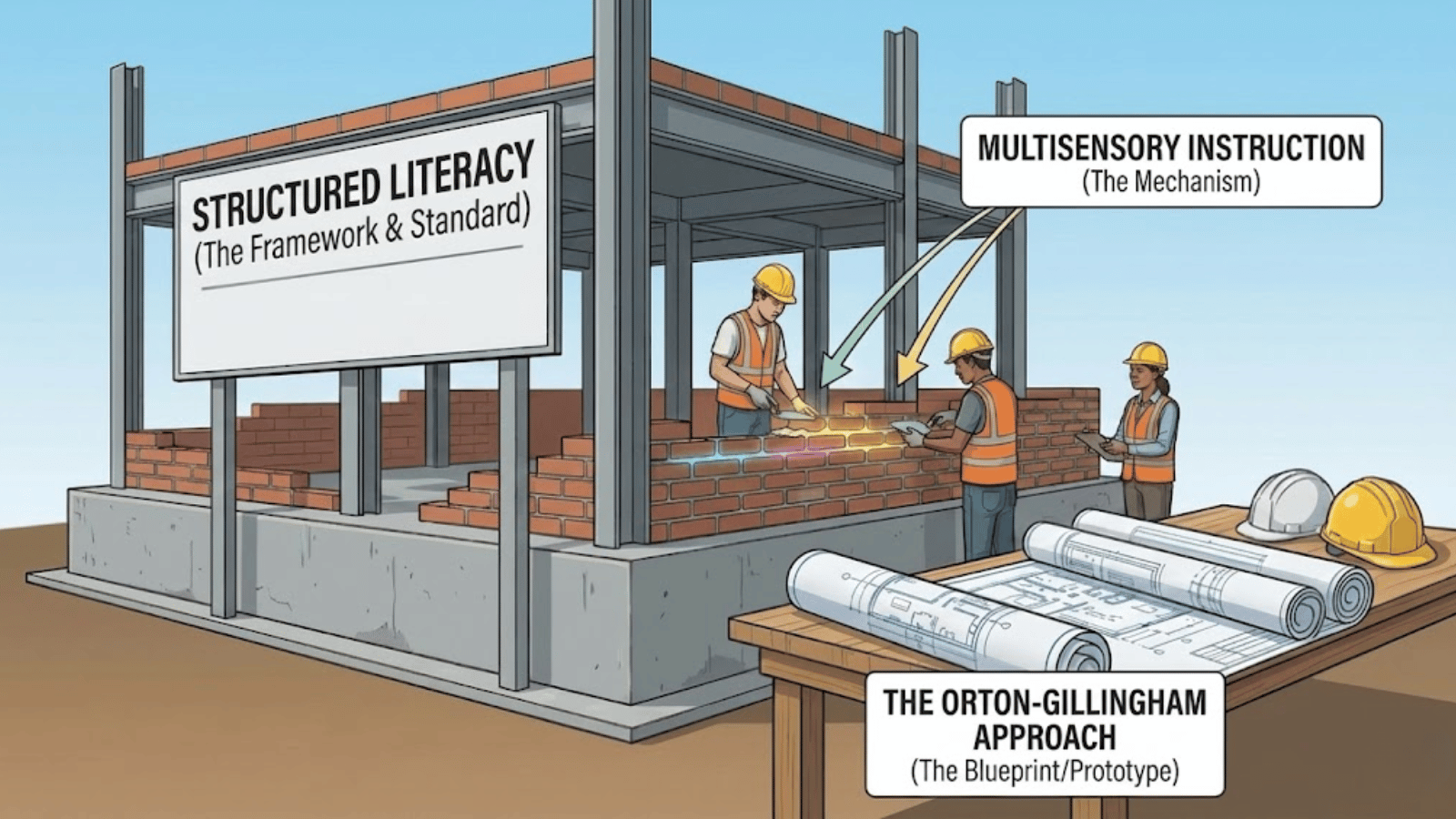
To remodel the brain's circuitry and construct a functional reading network, we need more than just exposure to books. We need a triad of intervention: Structured Literacy, Multisensory Instruction, and the Orton-Gillingham Approach.
Pillar 1
Structured Literacy (The Framework)
If literacy is a building, Structured Literacy is the architectural standard. It is the "What" and the "How" of teaching. It is not a specific commercial program you buy in a box; rather, it is an evidence-based framework that aligns with the Science of Reading.
Unlike methods that treat English as a chaotic list of words to memorize, Structured Literacy breaks the language down into a logical code that builds systematically—where nothing is taught randomly and every concept builds on what came before.
Phonology
The study of sound structure. Teaching students to hear and manipulate individual sounds (phonemes) that make up our language.
Morphology
Understanding syllables, word structure, and word parts—roots, prefixes, and suffixes—to unlock meaning and decode complex words.
Sequential & Cumulative
Everything builds in order. You're never given a word with pieces you haven't learned yet. Each lesson reinforces and builds upon previous ones.
Pillar 2
Multisensory Instruction (The Mechanism)
If Structured Literacy is the content, Multisensory Instruction is the engine that drives that content into long-term memory. It utilizes the VAKT model (Visual, Auditory, Kinesthetic, Tactile) to engage the whole brain.
"Neurons that fire together, wire together."
Dyslexia is often characterized by a disconnection between the visual processing areas (seeing the letter) and the phonological areas (hearing the sound). By forcing the student to see, say, and write simultaneously, we force these disparate brain regions to connect. This "cross-modal integration" builds the neural bridge that is missing.
Pillar 3
Explicit Instruction (The "No Guessing" Rule)
"Explicit" means nothing is left to chance, assumption, or discovery.
Many modern reading programs use "embedded phonics," where a teacher hopes a student notices a pattern while reading a story. This fails dyslexic students. Dyslexic brains often cannot intuitively infer patterns from just reading books.
In an explicit model, the teacher hands the student the rulebook directly.
"Look at the word 'phone'. Can you guess what sound 'ph' makes by looking at the picture?"
"The letters 'ph' together make the /f/ sound. Watch my mouth. Repeat after me: /f/. Now let's write it."
Putting it Together: The Orton-Gillingham Approach
If Structured Literacy is the standard, Orton-Gillingham (OG) is the blueprint that operationalizes it. It is the specific pedagogical method developed in the 1930s that brings these pillars together into a cohesive lesson plan.
It is the "prototype" of remediation. Authentic OG instruction is always structured, always multisensory, and always explicit.
The Proof is in the Imaging
Neuroimaging studies (fMRI), such as the landmark 2004 study by Dr. Sally Shaywitz at Yale University, have shown that after intensive Structured Literacy instruction, the dyslexic brain physically changes. We see increased activation in the left hemisphere reading network—the very areas that were previously underactive. This proves that with the right instruction, we can rewire the brain for literacy.
Comparative Overview
| Term | Analogy | Function |
|---|---|---|
| Structured Literacy | The Framework | The "What" and "How" (Phonology, Morphology, Sequential Learning) |
| Multisensory Instruction | The Mechanism | Using VAKT to consolidate memory & connect brain regions |
| Explicit Instruction | The Rulebook | Direct teaching with no guessing permitted |
| Orton-Gillingham | The Blueprint | The method that operationalizes all the above |
Building the Bridge
Dyslexia isn't a broken brain; it's a different wiring. These three pillars—Structured, Multisensory, and Explicit—provide the tools to build the bridge to literacy that your student deserves.
Scientific references: International Dyslexia Association