Blocked on the Expressway: A Visual Guide to How the Dyslexic Brain Reads
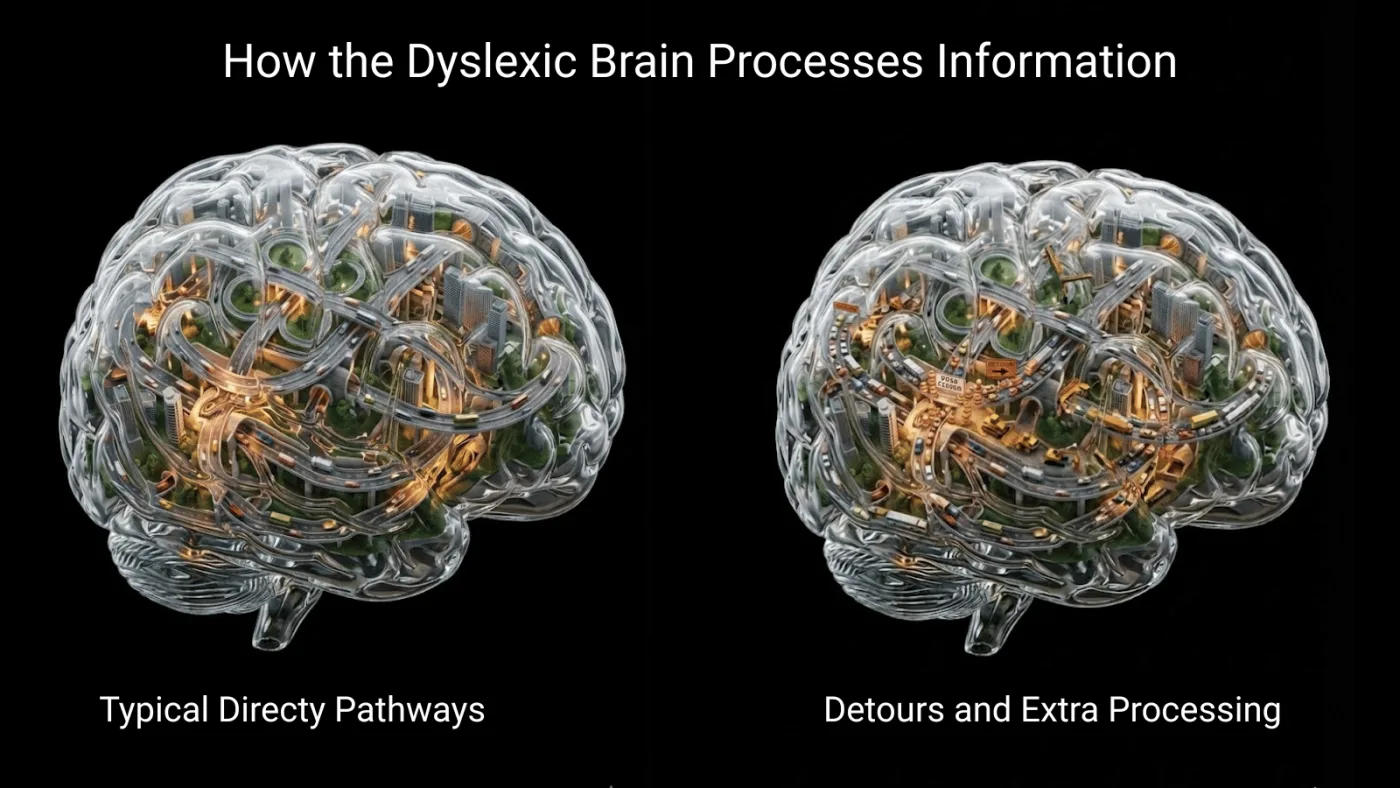
If reading feels hard for your child, validate that struggle immediately. Reading feels hard because, biologically speaking, it is hard.
We often compare reading to speaking, but they are fundamentally different. Speaking is a biological instinct; place a child in a room with people talking, and their brain will naturally absorb language. Reading, however, is a cultural invention. It is a relatively new technology in human history.
We are not born with a "reading center" in our brains. To learn to read, every single human being must physically restructure their brain to connect vision to language. For the dyslexic brain, this construction project encounters a significant roadblock.
The Brain as a Highway System
"Think of reading like driving a car through your brain. For most people, there’s a direct expressway: you see a word, and it zips instantly to the part of your brain that understands meaning... But for a dyslexic brain, that main expressway is blocked."
This short video visualizes why reading feels so labor-intensive for your child. It's not a lack of effort; it's a traffic jam.
The Neurotypical Brain
The "Expressway"
In a skilled reader, the brain builds a specialized network heavily lateralized to the left hemisphere. This network connects the visual cortex (seeing shapes) to the auditory cortex (hearing sounds).
The crown jewel of this network is the Visual Word Form Area (VWFA), located in the left occipito-temporal region.
How it works:
Once a word is mapped here, this area recognizes it instantly as a visual pattern. It allows for automaticity. The reader doesn't have to "sound out" the word; the information zips along the expressway directly to meaning. This is why you can read this sentence without pausing to think about the letters.
The Dyslexic Brain
The "Traffic Jam"
When we look at fMRI scans of dyslexic brains while reading, we see a distinct difference. There is significant hypoactivation (under-activity) in that critical posterior "expressway" (the parieto-temporal and occipito-temporal regions).
Essentially, the road is closed. The neural wiring that allows for instant, automatic word recognition is under-developed or blocked.
Hypoactivation
The "Expressway" (Left Hemisphere) is dark or quiet on brain scans.
No Automaticity
Without this route, every word feels new, no matter how many times it has been seen.
The "Detour": Why Reading is Exhausting
The brain is resilient. If the main highway is blocked, it finds another way. This is the "Detour."
To compensate for the blockage, the dyslexic brain recruits areas in the Frontal Lobes (Broca's area) and the Right Hemisphere. These areas are designed for articulation and holistic imagery, not for rapid, granular word analysis.
The High Cost of the Scenic Route
Imagine taking winding back roads instead of the highway. You eventually get to your destination, but it takes twice as long and uses twice the gas.
- Inefficiency: This route relies on manual decoding (sounding out) rather than instant recognition.
- Cognitive Load: Because the brain is working overtime on these back roads, the student is often exhausted after reading just a few paragraphs.
We Can Build a New Bridge
The good news is that the brain is plastic. We can't just tell a child to "try harder" on the detour; that only leads to burnout. We need to build new pathways. We do this through a specific engineering plan called Structured Literacy.
Scientific references: NICHD - Reading Disorders • Yale Center for Dyslexia & Creativity