b and d reversals: the thumbs-up trick
Mixing up b and d is one of the most common bumps in learning to read. One hand gives a quick way to check: birds fly up, penguins dive down.
PDF, 7 pages, 1.9 MB · No sign-up
The trick
Three pictures to remember
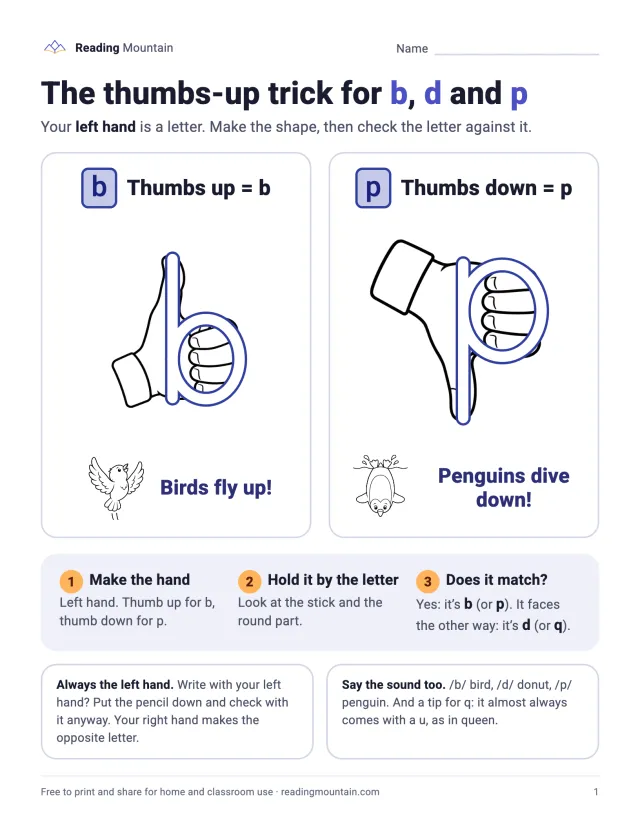
Use the left hand every time. Make the shape, hold it next to the letter, and say the sound.
 1
Thumbs up = b
Make a thumbs-up with your left hand. The thumb is the stick. The fist is the round part. b says /b/, like bird.
Birds fly up!
 2
Faces the other way? d
Hold your hand next to the letter. If the round part faces the other way, it does not fit your fist. It’s d, like donut.
Doesn’t match? It’s d.
 3
Thumbs down = p
Now turn your thumb down. The stick points down, below the line. p says /p/, like penguin.
Penguins dive down!
Left-handed? Still use the left hand: the right hand makes the opposite letter. Put the pencil down for a moment and check.
What about q? With the thumb down, a letter that faces the other way is q. And q almost always comes with a u, as in queen.
Practice
Try it out
Before tapping, make the hand and hold it up to the screen. Every right answer plays the letter’s sound.
Which letter is it? Check it with your hand.
Why it happens
The brain is built to ignore direction
A cup is still a cup when its handle points left or right. Our visual system learns early that direction does not change what something is.
Letters break that rule. b and d are the same shape, facing different ways. Learning to read means teaching the brain that, for letters, direction matters, and that takes practice.
For parents
Is it a sign of dyslexia?
Common, and usually outgrown
Most children stop reversing b and d by about age 7 or 8, around the end of second grade.
Not a sign on its own
Many young children reverse letters with or without dyslexia. Dyslexia is not seeing letters backwards; it usually shows up as trouble linking letters to sounds.
When to ask for help
If reversals keep going past second grade, or come with slow, effortful reading or guessing at words, ask about an evaluation. Find help in your state.
Free printable
b, d and p practice worksheet
- 1The thumbs-up trick on one page, to keep by the desk
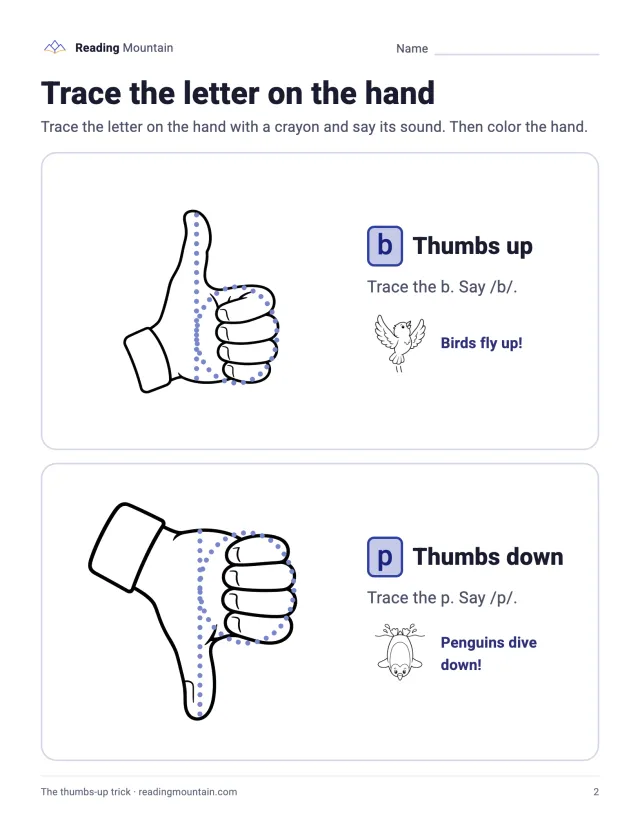
- 2Trace the b and the p on the hand, then color it in
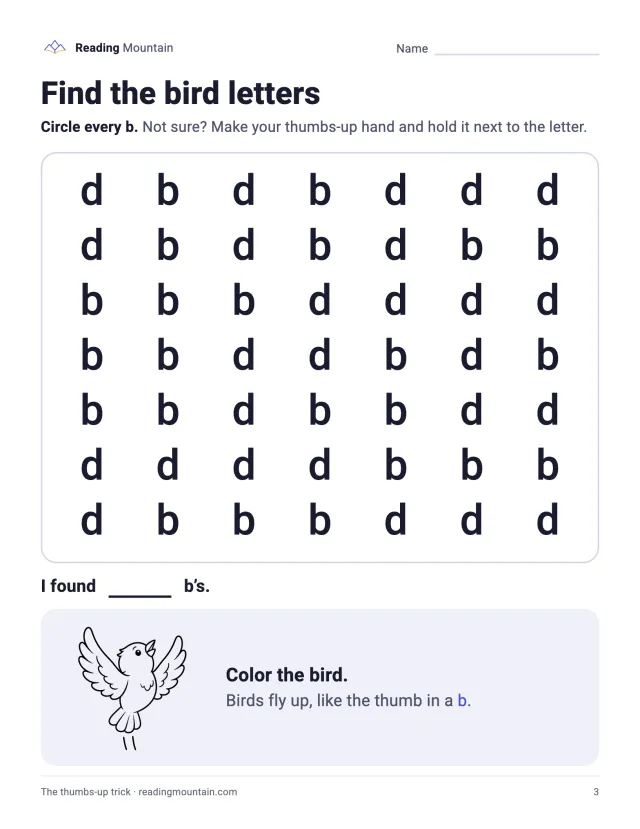
- 3Find the bird letters: circle every b
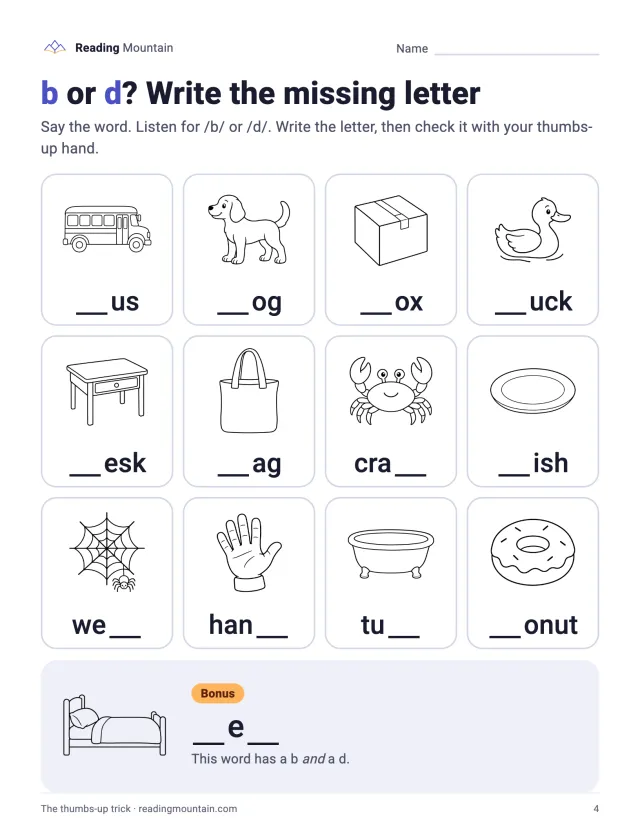
- 4b or d? Fill in the missing letter under each picture
- 5Thumbs down = p, with a tip for q
- 6Trace b, d and p, then read short words
- 7Answer key and notes for parents and teachers
PDF, 7 pages, 1.9 MB · Free for home and classroom use
More ways to help
Small habits that stick
One letter at a time
Make b solid before adding d, instead of drilling the two together from the start.
Sound every time
Say /b/ while finding, tracing or writing a b. The sound is what reading needs.
Trace it, say it
Trace the letter on the hand outline with a finger while saying its sound. Seeing, moving and hearing it together helps it stick.
Little and often
Five minutes a day beats one long session. The hand is for checking, and it fades as the letters stick.
Questions
b and d reversals: FAQ
At what age should b and d reversals stop?
Reversing b and d is common in young children. Most stop by about age 7 or 8, around the end of second grade. If reversals keep going after that, or come with other reading struggles, ask a teacher or a specialist about an evaluation.
Is reversing b and d a sign of dyslexia?
Not on its own. Many young children reverse letters whether or not they have dyslexia, and dyslexia is not a problem of seeing letters backwards. Reversals that last past second grade, together with trouble linking letters to sounds or slow, effortful reading, are worth checking.
What is the best trick for b and d?
Pick one reference that is always at hand, and pair it with the sound. In the thumbs-up trick the left hand makes a b: the thumb is the stick and the fist is the round part. A letter that does not match the hand is d. Another well-known version is the bed trick, where two fists make the word bed.
How do you tell p and q apart?
Turn the left thumb down. The hand now looks like a p: penguins dive down. A letter that faces the other way is q, and in English q almost always comes with a u, as in queen and quilt.
Does the trick work for left-handed students?
Yes. Always use the left hand, because the right hand makes the opposite letter. A left-handed writer can put the pencil down for a moment to check.
Reading Mountain
Tricky letters, taught step by step
In Level 1, students meet b, d and p in interactive lessons: they flip the letter, lay it on the hand, and watch the bird fly up. Then they practice every sound with Orton-Gillingham lessons, spelling and decodable books.
Sources
- Dehaene et al. (2010), How learning to read changes the cortical networks for vision and language, NeuroImage
- Treiman et al. (2014), Children’s letter reversals and later reading, Scientific Studies of Reading
- Understood: FAQs about reversing letters and dyslexia
- Yale Center for Dyslexia & Creativity: Dyslexia FAQ
- International Dyslexia Association: Dyslexia Basics