Best Dyslexia Reading Apps and Online Programs Compared
Search for a dyslexia reading app or an online dyslexia program and the same names tend to appear: Readability, Ello, Lexia PowerUp, Nessy, and Reading Plus.
They are not interchangeable. Some focus on reading practice, some are school interventions, and others are mainly built for fluency or comprehension.
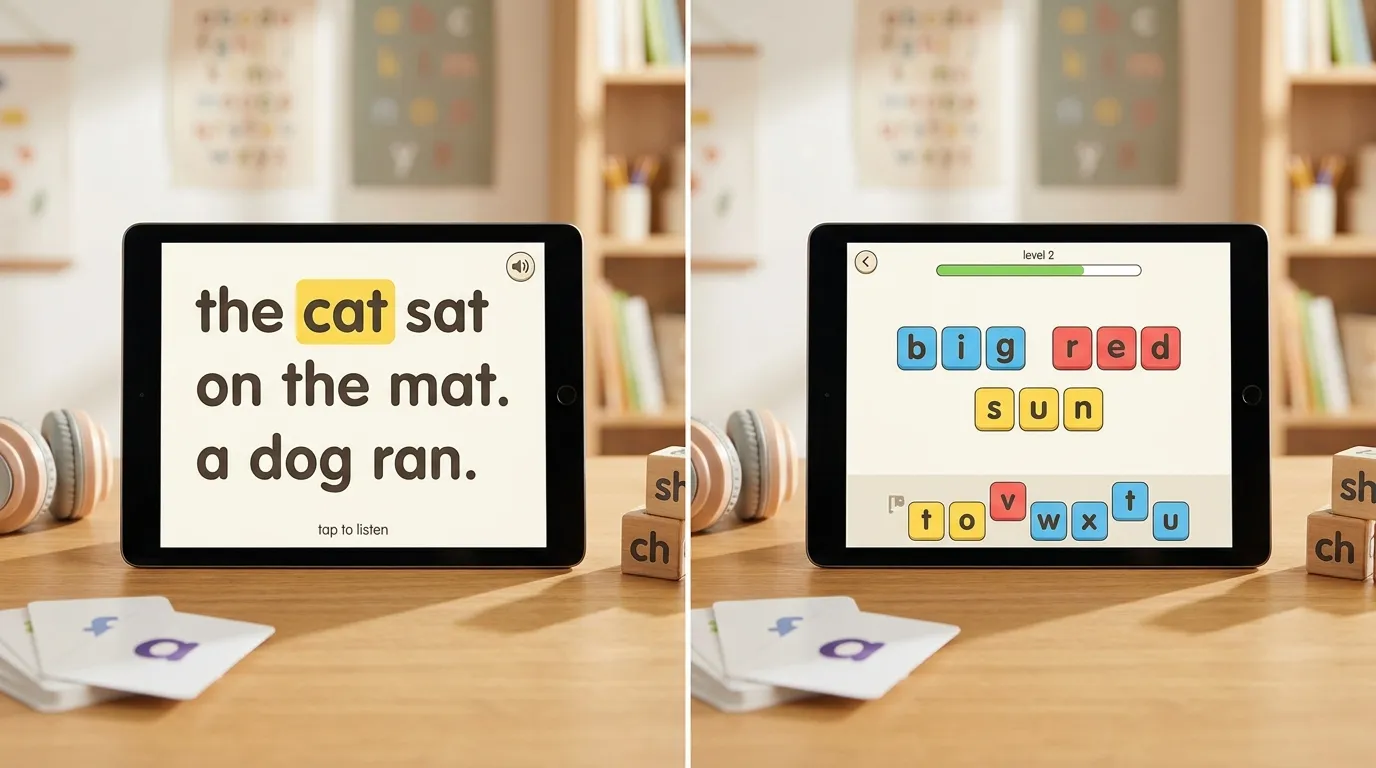
What to Look For in a Dyslexia App
When comparing dyslexia apps, it helps to look beyond the size of the book library. The strongest fit depends on whether the student needs explicit instruction, guided practice, fluency support, writing support, or some combination of those pieces.
Does it explicitly teach phonics patterns, or mostly give reading practice?
Are students reading decodable text that matches what they just learned?
Does the program include spelling and writing, or only read-aloud practice?
The Quick Answer
If you want read-aloud practice, start by comparing Readability and Ello.
If you want a dyslexia-specific at-home program for a younger learner, Nessy deserves a look.
If your school offers older-student intervention, Lexia PowerUp is the serious institutional option.
If decoding is already solid and the issue is fluency or comprehension, Reading Plus may fit.
Side-by-side
Dyslexia Reading Apps Compared
Product details change, so treat device support and availability as something to confirm before subscribing.
| Program | Main role | Best fit | Strength | Things to consider |
|---|---|---|---|---|
| Readability | AI read-aloud practice | K-6 readers who need fluency, accuracy, and comprehension support | Broad device support, speech feedback, comprehension questions | Not primarily a decodable, structured-literacy sequence |
| Ello | AI reading coach with decodable books | Younger readers on iPhone or iPad | Decodable library, phonics quests, gentle learner-centered feedback | Younger range, iOS only, supplemental rather than comprehensive |
| Lexia PowerUp | School-based adolescent literacy intervention | Grades 6-12 students in schools using Lexia | Strong research base, Word Study, Grammar, Comprehension | Built mainly for schools; progression can feel confusing for some students |
| Nessy Reading & Spelling | Structured literacy program | Ages 6-11 working on dyslexia-focused phonics and spelling | Science-of-reading sequence, games, worksheets, spelling | Can feel young for older students; not a full curriculum |
| Reading Plus | Silent reading fluency and comprehension | Grades 3-12 students who can already decode | Comprehension, vocabulary, silent reading stamina | Not the starting point for a student who still needs decoding |
Program notes
Short Blurbs on the Most Common Options
Readability
Best viewed as AI-supported reading practice
Best for: Families who want an app that listens while a learner reads aloud, gives real-time support, and tracks fluency and comprehension.
Strengths
- Strong read-aloud workflow with AI correction and encouragement.
- Comprehension support through voice-based questions and reports.
- Useful device flexibility for families using tablets, Chromebooks, or laptops.
Things to Consider
For dyslexia, the main caveat is sequence. Readability is helpful practice, but it is not primarily a full Orton-Gillingham-style program where every phonics concept is explicitly taught, spelled, written, and then practiced in decodable text.
Ello
Strong early-reading practice, especially for iOS families
Best for: Younger readers who can already read simple sentences and need decodable books with a patient reading coach.
Strengths
- Uses decodable books and phonics-based reading support.
- The app breaks stuck words into sounds or syllables instead of simply giving the answer.
- The tone is intentionally gentle, which can help learners who shut down during reading.
Things to Consider
Ello is clear that it is a supplement, not a comprehensive dyslexia intervention. It is also limited to iPhone and iPad, and it is aimed more at younger readers than older struggling students.
Lexia PowerUp Literacy
A serious school intervention for older readers
Best for: Middle and high school students whose schools use Lexia as part of a literacy intervention plan.
Strengths
- Designed for grades 6-12 and older struggling readers.
- Covers Word Study, Grammar, and Comprehension with personalized pathways.
- Has a stronger formal research story than many app-based options.
Things to Consider
PowerUp is built mainly for schools, where teacher data and offline lessons are part of the implementation. Some students and families report that the progression can feel hard to follow or uneven, so it may work best with an educator helping interpret what the program is assigning and why.
Nessy Reading & Spelling
A dyslexia-focused at-home option for younger learners
Best for: Learners ages 6-11 who need explicit phonics, spelling, and confidence-building practice at home.
Strengths
- Structured literacy sequence built around phonological awareness, phonics, spelling, morphology, and comprehension.
- Game-based lessons keep many younger students engaged.
- Includes printable worksheets and offline practice, which many dyslexic learners still need.
Things to Consider
Nessy is a strong fit for younger learners, but some older students may find the style too young. It is also not a full curriculum, so families may still need additional reading, writing, and literature work alongside it.
Reading Plus
Useful for fluency and comprehension after decoding is established
Best for: Students in grades 3-12 who can already decode but need silent reading stamina, vocabulary, and comprehension growth.
Strengths
- Focuses on silent reading fluency, comprehension, vocabulary, and motivation.
- Uses assessment and reporting to personalize instruction.
- Can help students who read accurately but slowly or with weak comprehension.
Things to Consider
Reading Plus is not the best starting point for dyslexic learners who still need explicit decoding and spelling instruction. It assumes too much if the alphabetic code is not secure.
How to Choose
Choose Ello if you have a younger iOS learner and want decodable reading practice. Choose Readability if device flexibility and comprehension support matter most.
Choose Nessy if you want a friendly structured-literacy program for a younger learner. Ask about Lexia PowerUp if an older student's school is looking for an intervention with a stronger research and reporting infrastructure.
Keep Reading Plus in the fluency-and-comprehension lane. It can be useful later, but it is not the first stop for a student still guessing at words or missing foundational phonics.
If the goal is a single app-based path, look for a program that connects explicit instruction, spelling, writing, and decodable books rather than treating those pieces as separate add-ons.
Frequently Asked Questions
What is the best dyslexia reading app?
There is no single best app for every student. In an Ello vs. Readability comparison, both are useful reading-practice tools, with Ello leaning younger and decodable and Readability offering broader device support. Nessy is a more dyslexia-specific structured program for younger learners, Lexia PowerUp is a school intervention for older readers, and Reading Mountain is built to combine explicit instruction with AI-supported practice.
Are read-aloud apps enough for dyslexia?
Usually no. Dyslexic learners typically need explicit, systematic instruction in phonemic awareness, phonics, spelling, and writing. Reading aloud with AI support can be helpful, but it works best when it follows clear instruction.
Should dyslexia apps use decodable books?
Yes, especially while a learner is still learning the code. Decodable books let students practice patterns they have already learned, which lowers guessing and builds confidence.
A connected sequence
How Reading Mountain fits in
If you are looking for a more connected structured-literacy path than a practice-only tool, Reading Mountain is built around explicit reading, spelling, writing, and decodable books in one sequence.
| Program | Core approach | What the learner practices | Why it matters |
|---|---|---|---|
| Reading Mountain | Structured literacy with AI-supported listening | Reading with tiles, spelling with tiles, reading words and sentences, writing sentences, and decodable books | Keeps instruction and practice connected so students apply the same concepts across reading, spelling, writing, and books |